
does protest even work anymore?
probably should ask the question while we still can

For many years I’ve been asked whether protests and rallies are “worth it”. Do leaders pay any attention?
In recent years we’ve marched for the climate, reproductive freedom and for Palestine. And yet fossil fuel extraction dialled up, Roe was overturned and Gaza continued to be genocided. The anti-ICE and No Kings protests in the US brought out record crowds, but the situation there has only worsened.

But given the extent to which governments around the world are now trying to stop citizens from exercising the age-old democratic right to protest, one would think they do still work
But also given these bans and clampdowns (and ICE killings and Iranian massacres), it’s probably a good time to reconsider whether protests (and rallies, marches and other non-violent public displays of resistance) are the most effective way go about protecting and defending ourselves now.
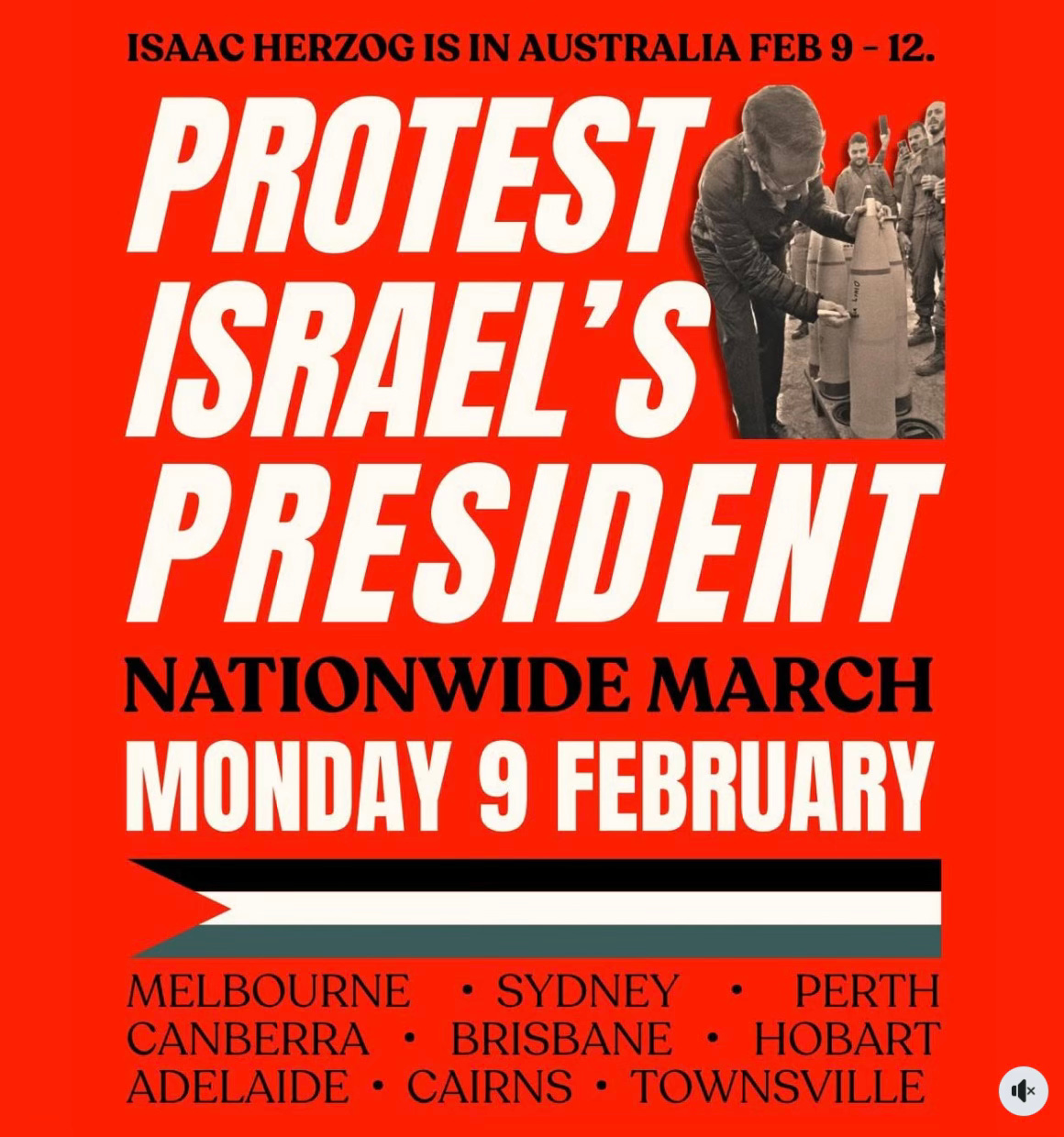
A pragmatic discussion is particularly pertinent given I’m now (suddenly) back in Australia where the most draconian anti-protest laws in the nation’s history have just kicked in. These bans have just been extended to cover Israeli President Isaac Herzog's official visit next week around which nationwide peaceful rallies have been organised. Herzog, of course, has been named by the United Nations commission of inquiry on the occupied Palestinian territory as having incited genocide against Gaza.1 Frankly my head is reeling. The country is seeking “social cohesion” (I detect this is the latest national phrase after only a few days back) and the Prime Minster decides to do this??
Reader Nicole yesterday pointed me to news of one of the first Australians to be arrested under these new amped-up laws2 - Theo Nolan-Isles, a 37-year-old “larrikin” welder from Sydney who only found his political voice after witnessing the genocide unfold in Gaza. He wrote a satirical post on X (directed at politicians, not the Jewish community or individuals)3 and was arrested by police, “shuffled between multiple correctional facilities and granted limited - if any -contact with his lawyer, doctor or loved ones, and could face federal charges”.
I’d been wondering when the ludicrous over-reach would commence. I’ve not once believed Australia would remain immune to fascist creep.
I’m not sure whether Australians are aware that the nation has one of the weakest protest protections in the democratic world — it’s an outlier among liberal democracies in having no explicit legal right to protest. Not constitutionally. Not in a bill of rights. Not as a standalone statutory right. There’s an implied freedom of political communication, but how and when you’re able to exercise it is at the discretion of the police and the State. Which is precisely why Australians should be really worried about these latest laws.

Anyway. To answer …
Does protest work?
TL;DR: Yes! And No! But - crucially - we must do it while we still can.
I’ll break down the longer answer in a bunch of points that layer up into the beginnings of a discussion that we can continue in the comments. Read to the last point - a real brain dance for those of you who like such things.
Yes, protests work…in good times (historically speaking). As Rachel Donald at Planet: Critical wrote, “Non-violence is an effective tactic in the arsenal of self-defence – if history allows.” Which is to say, when we are living in a stable democracy with leaders who care about being liked and respond to popular demands. Undoubtedly protests shift thinking; they “hypernormalise care and collective engagement in moral values; they keep the Overton window in line with where we, the humans, are at; they allow our leaders, like Canadian PM Mark Carney last week at Davos, to make speeches that further open that window (because said leaders feel backed by the rallying masses). Plus, there’s that “figure of hope” I’ve been citing for years that says when 3.5% of the population of a country (or other entity) protest nonviolently against an authoritarian government, that government is likely to fall from power. The notion extends to other democratic demands, too.?4
Protest works when it’s witnessed. I throw this in as a reminder (because I touched on it last month): Not everyone has to show up with a cardboard sign and chant. But all of us have a responsibility to support those who do, share and like and comment on their videos, etc.

Flipside, protests stop working as soon as authoritarianism even begins to creep in. Even the early signs (downgrading education, denigrating intellectuals and experts, weakening independent journalism) give leaders the green light to stop caring about, or having to respond to, citizens.
Commentators and historians such as Timothy Snyder, Hannah Arendt and Robert Paxton tend to see the banning of protests as the point of no return in the fascist slide. It’s at this point that collective resistance is broken. **Read this point twice.
As tyranny descends, protests are weaponised. Which is what we’re seeing in the US. A theory I’ve been flagging here for some time is that the Trump regime is now stoking its citizens (in Minneapolis, currently) into resistance and protest to then use as the trigger they seek to bring in nationwide martial law, which would in turn result in the cancelling of the both the 2026 midterms and the 2028 election. I feel that if there’s a slight slip in the non-violent pact the Minneapolis community seems to have made, then the house of cards goes down.
Australia, Canada, the UK and much of Europe are in the precarious, liminal phase where protesting anti-protest laws (in particular) matter more than ever! The preceding points set out why, yeah?
But, of course, that neoliberalism was designed to absorb and minimise protest and resistance, not respond to it. This should be borne in mind. Subscriber Justin McAffee who writes at Collapse Curriculum shared recently:
This is the terminal logic of neoliberalism: freedom of speech without power over outcomes….The system has evolved to digest dissent, metabolize protest, and convert rebellion into brand engagement.
This is quite something to become alive to. I’m thinking about how this actually looks. We can buy “resistance” hoodies made in sweatshops, for example. And green activists are targeted with META ads for “green investment portfolios.”
McAffee adds:
To ask this system to reform is like asking a virus to heal its host.
Which essentially does mean that as the neoliberal superstructure reaches its “extinction burst” moment we are going to see the snake eat it’s own quasi-liberal tail.
The critical theory teacher Louisa Munch explained in one of her excellent videos recently that our understanding of struggle has always operated to the notion that when the powerless suffer sufficiently at the hands of the powerful, resistance erupts, giving way to protest and eventually revolution and, yes, to change. Think the French Revolution. Think how feudalism became capitalism.
However, now that capitalism and neoliberalism has done us all in, something weird has happened. Revolution beyond neoliberal suckholedom has become impossible because it’s actually upgraded to become technofeudalism, which has (further) stopped us from imagining anything outside of capitalism and neoliberalism. And so, instead of rising up from the pain and struggle, instead of being able to attain the critical protest momentum, we shop and scroll and allow the Tech Bros to take our liberty.
She argues:
“The revolution won’t be televised. It’ll be commodified. You’ll be able to buy the T-shirt.”
Watch the whole thing to get the message.
So what now?
If you’re in Australia or anywhere where protesting and peacefully resisting is in jeopardy and the government leaders retain a semblance of sanity and decency, get out and protest anti-protest laws peacefully. Now! The protests on Monday in Australia are in many ways such a protest. (I’m happy to discuss in the comments why I’ll be going in spite of the bans, if you like.) Support the activists who are challenging the bans in court (see the footnote below).
In the US, where the focus is now on self-defence, rather than protesting to retain rights, there are very interesting discussions being had about using various forms decentralised networks of resistance to hold onto liberties. This The Noösphere essay about learning how to topple the patriarchy from female bonobos is fun and helpful.
Justin McAfee writes:
What we need now is not another viral protest in hopes of convincing the ruling class that we are really serious! What we need now is a dramatic cultural shift toward operational mentality.
But fundamentally, as Louisa Munch and others (and myself) argue, we must continue to imagine beyond the current system to ensure any kind of change for good can happen. We need to protest not to save neoliberalism, but to go beyond it.
We must educate ourselves, we must remain engaged, we must (I’ll say it again) share, like and comment on each other’s posts that are trying to name and educate and engage. Protests are still not a bad way to go about doing this, of course.
My goodness, I really can’t believe I’ve become this militante (the French word for activist) at this age. But here we are, hey…
Sarah xx
PS My mum today whispered to me something that I think is relevant here. She told me I’m right to be fighting what is happening to the world. All of us here are, as surreal as it feels.
Here’s a link to write a letter to Senator Penny Wong calling for Herzog to be investigated for genocide crimes. There are many others about the place. Feel free to share them in the comments.
Activists have launched a legal challenge arguing the ban is unconstitutional because it impermissibly burdens the public’s implied freedom of speech. A United Nations special rapporteur with a focus on protecting human rights after terrorism events has sought to intervene in the case.
It was an offer of a free beer to anyone who caused “physical pain to any politician who voted Aye to the passage of the ‘Combating Antisemitism’ hate speech bill”. It should be noted, one year ago a Zionist activist placed a homemade bomb on Theo’s car and was not charged under the terrorist act.
Based on a thesis developed by Erica Chenoweth.
Sarah Stein Lubrano's book Don't talk about Politics shows that protests don't change policy makers minds but they are a good step to helping people take action, and that first step leads to the next more meaningful step e.g. getting more involved in organizing. The protests of old required much more organizing so that also had more meaning. In some ways the ease of communication now means we don't have to put much skin in the game. From collective action science, it's much better to act together to do something e.g. beach clean up, because you become a doer - rather than just a protester - and our brains will rewire the rest so more doing follows.
“Protests work when witnessed” — you’re so right Sarah. I don’t know if you have seen the clip of those Minnesotans protesting by singing outside of a hotel where ice agents are staying? Its one of the most moving things I’ve witnessed in a long time.